June 10, 2026
5 types of business documents companies translate with AI, and what each one actually requires
Most businesses approach AI document translation by choosing a tool first. They upload a document, evaluate the output, and if it looks right they proceed. If it doesn't, they try a different tool.
The problem is that "looks right" means different things depending on the document. A clause that translates fluently in a marketing brochure can fail quietly in a legal contract. A financial sentence that five AI models agree on can still create a terminology inconsistency across a 40-page report. An HR clause can appear fully translated into German while carrying a legal meaning that German employment law does not recognise.
The document type is the starting variable, not the tool. Once you understand what each type actually requires from an AI translation engine, choosing and configuring that engine becomes much clearer.
We ran five types of business documents through MachineTranslation.com, a platform that translates with 22 AI models at once and surfaces where they agree, where they diverge, and which terms require human review before a document is used. Here is what each type showed.
Table of Contents
- Why document type is the starting variable
- Legal contracts and NDAs
- HR and employment documents
- Financial reports and statements
- Formatted business documents and technical files
- Compliance and regulatory filings
- What these five document types have in common
- Frequently asked questions
Why document type is the starting variable
The distinction that matters between document types is not complexity, it is consequence. Each category carries a different risk profile when translation introduces an error, and a different set of requirements the AI must meet.
| Document type | Primary translation risk | How single-model AI typically fails |
|---|---|---|
| Legal contracts and NDAs | Enforceability | Preposition or pronoun choices that shift liability scope invisibly |
| HR and employment documents | Jurisdictional compliance | Concepts that have no legal equivalent in the target country |
| Financial reports | Cross-document consistency | Accurate but inconsistent terminology across sections |
| Technical and formatted documents | Accuracy + usability | Layout degradation; terminology drift across a long document |
| Compliance and regulatory filings | Regulatory standing | Generic paraphrases of jurisdiction-specific regulatory terms |
A single AI model produces one output for each of these. It does not tell you which terms have no equivalent in the target language. It does not show you where other models disagree. It does not flag which phrases need a specialist before the document is signed, filed, or distributed.
The tests below show what changes when all of that is visible at once.
Legal contracts and NDAs
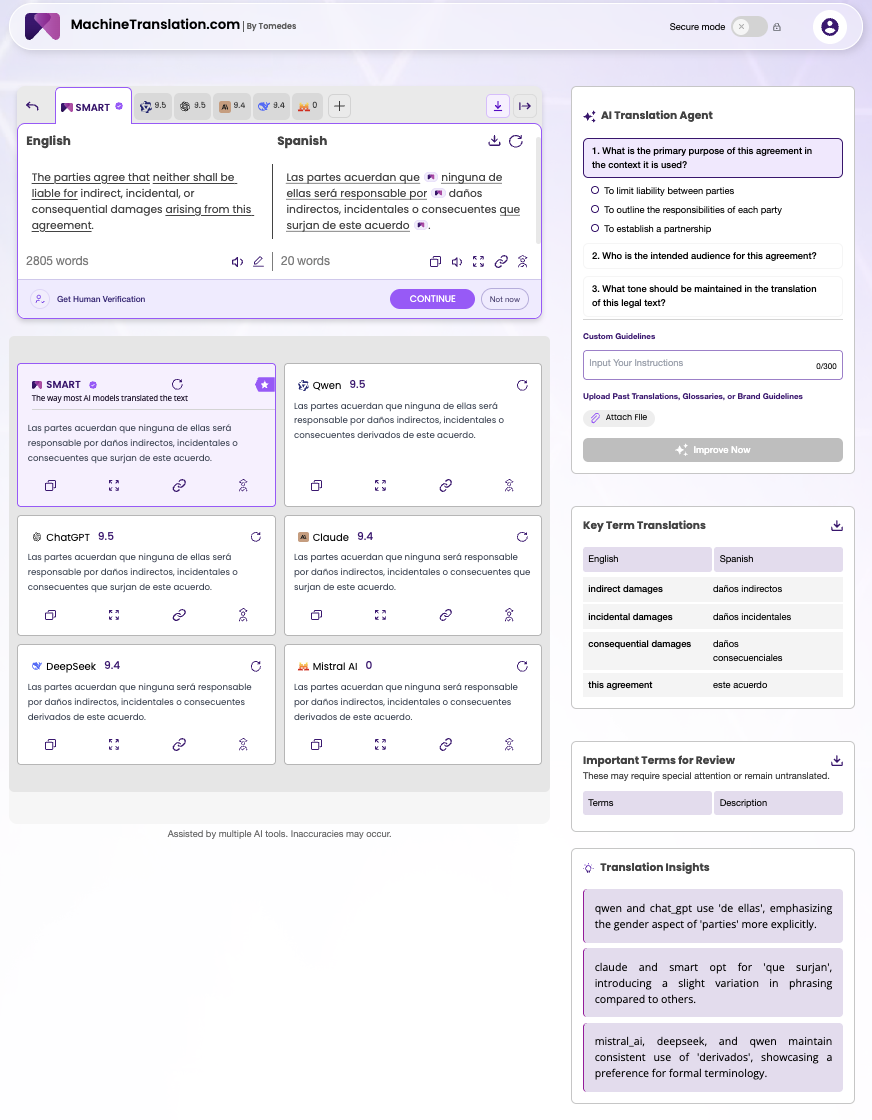
We tested a standard limitation of liability clause: "The parties agree that neither shall be liable for indirect, incidental, or consequential damages arising from this agreement." Run through MachineTranslation.com from English into Spanish, the clause was processed across five major AI models simultaneously.
Four of the five returned outputs scoring between 9.4 and 9.5. Mistral scored 0, a failure to produce a usable result. On a platform that routes translations silently through a single model, a Mistral failure would either be masked by an automatic fallback or delivered to the user without any quality signal. Here, it was visible immediately.
The more instructive finding came from the four outputs that passed.
Two models (ChatGPT, and Claude) translated "arising from" as "que surjan de." Qwen and DeepSeek used "derivados de" instead. Both are grammatically correct Spanish. The semantic difference is not. Surjan implies emergence or occurrence, damages that arise in the course of performance. Derivados implies derivation, damages that originate from a causal chain connected to the agreement. In a limitation of liability clause, the scope of what the limitation actually covers can depend on exactly this distinction.
MachineTranslation.com's Translation Insights panel identified the divergence automatically: "mistral_ai, deepseek, and qwen maintain consistent use of 'derivados', showcasing a preference for formal terminology." A second divergence (whether to include the pronoun "de ellas" after "ninguna," making the reference to parties explicit) split the models again. Qwen and ChatGPT included it. Claude and DeepSeek omitted it. In Spanish legal drafting, the presence or absence of that pronoun affects how the subject of the limitation is read.
Neither divergence would be caught by a translation quality score. Both were surfaced by comparing models.
This is the practical implication of AI translation for legal documents: the sentences that score highest are often the ones that conceal the most consequential variation. High accuracy on individual clauses is not the same as reliable output for a contract that will be signed and enforced.
HR and employment documents
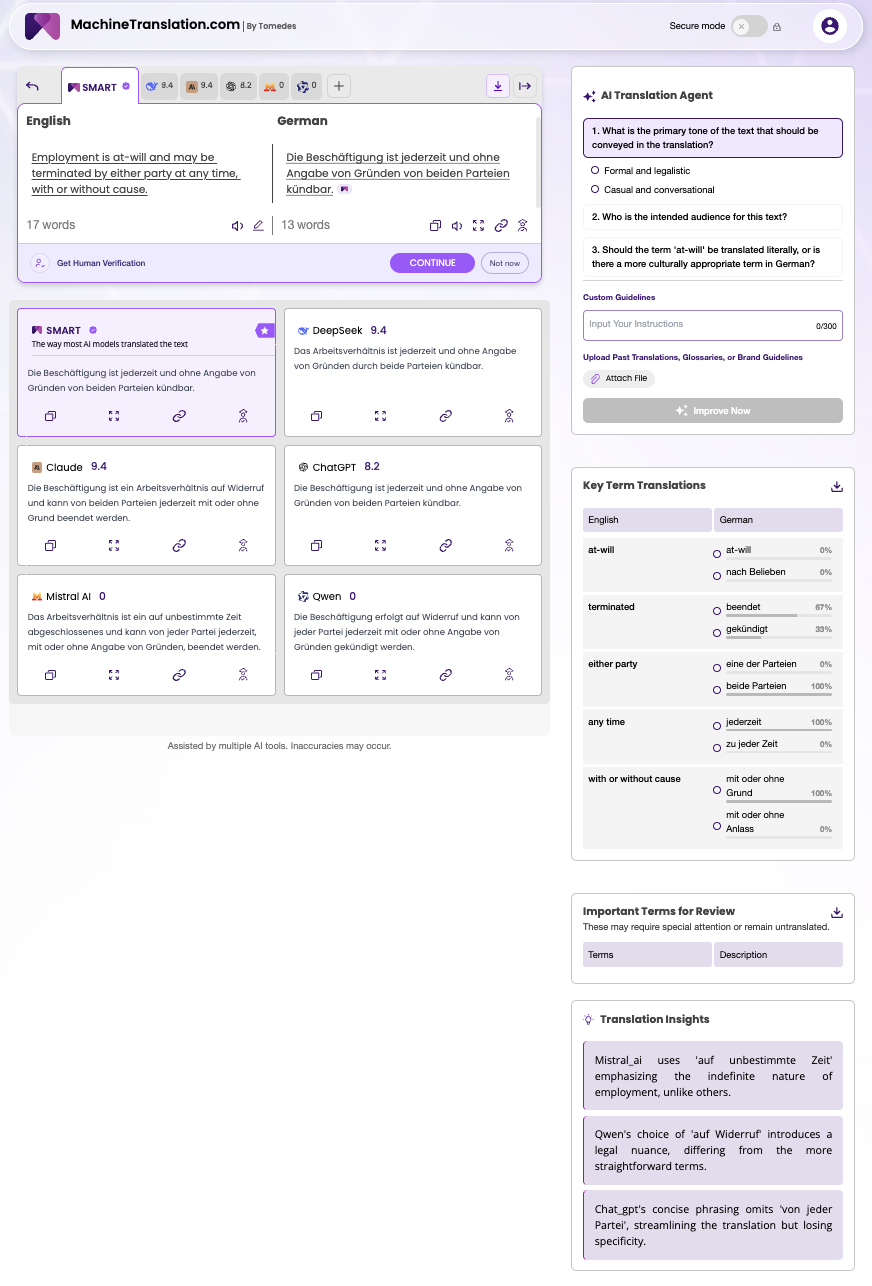
The HR test phrase was: "Employment is at-will and may be terminated by either party at any time, with or without cause."
Routine language in a US employment contract. And from a German legal perspective, largely untranslatable — not because of vocabulary, but because of jurisdiction.
"At-will employment" is a doctrine of US common law. It permits an employer to terminate an employee at any time, for any reason or no reason, without legal liability (absent a specific statutory protection). Germany's Kündigungsschutzgesetz (the Protection Against Dismissal Act) does not recognise this doctrine. After a statutory probationary period, German law requires justified grounds for termination. Translating "at-will" into German is therefore not a linguistic question. It is a legal question about how to represent a concept the target legal system does not contain.
MachineTranslation.com's Key Term Translations panel showed 0% model consensus on the term "at-will." Both candidate renderings — the literal "at-will" left untranslated, and the loose equivalent "nach Belieben" (at will, informally) — received no agreement across models. The platform's AI Translation Agent surfaced the issue directly, asking: "Should the term 'at-will' be translated literally, or is there a more culturally appropriate term in German?"
The model outputs diverged in a way that illustrates exactly why this matters:
- DeepSeek and ChatGPT produced functional German phrasing — "jederzeit und ohne Angabe von Gründen kündbar" (terminable at any time without stating reasons) — describing the practical effect of at-will without invoking a German legal term.
- Claude used "Arbeitsverhältnis auf Widerruf" (employment relationship subject to revocation), which is a recognised concept in German civil law — but refers to a specific contractual arrangement, not to the general at-will doctrine. The legal implication is different.
- Qwen used "auf Widerruf" similarly, introducing a German legal category the source text does not contain.
- Mistral scored 0.
- ChatGPT scored 8.2 (the lowest passing score) and the Translation Insights panel noted that its phrasing "omits 'von jeder Partei', streamlining the translation but losing specificity." In an employment contract, whether both parties hold the termination right is not a minor detail.
A single-model translation of this clause would return one of these outputs and present it as complete. Several are linguistically fluent. Some introduce German legal concepts the source document never intended. One quietly removes a key specification. None of this is visible without comparison.
For any organisation translating HR and employment documents into German (or into any civil law jurisdiction), the relevant question is not whether the AI can translate the sentence. It is whether the platform will tell you when the sentence contains a concept the target legal system does not recognise. MachineTranslation.com's English to German translation surfaces that flag. Most single-model tools do not.
Financial reports and statements
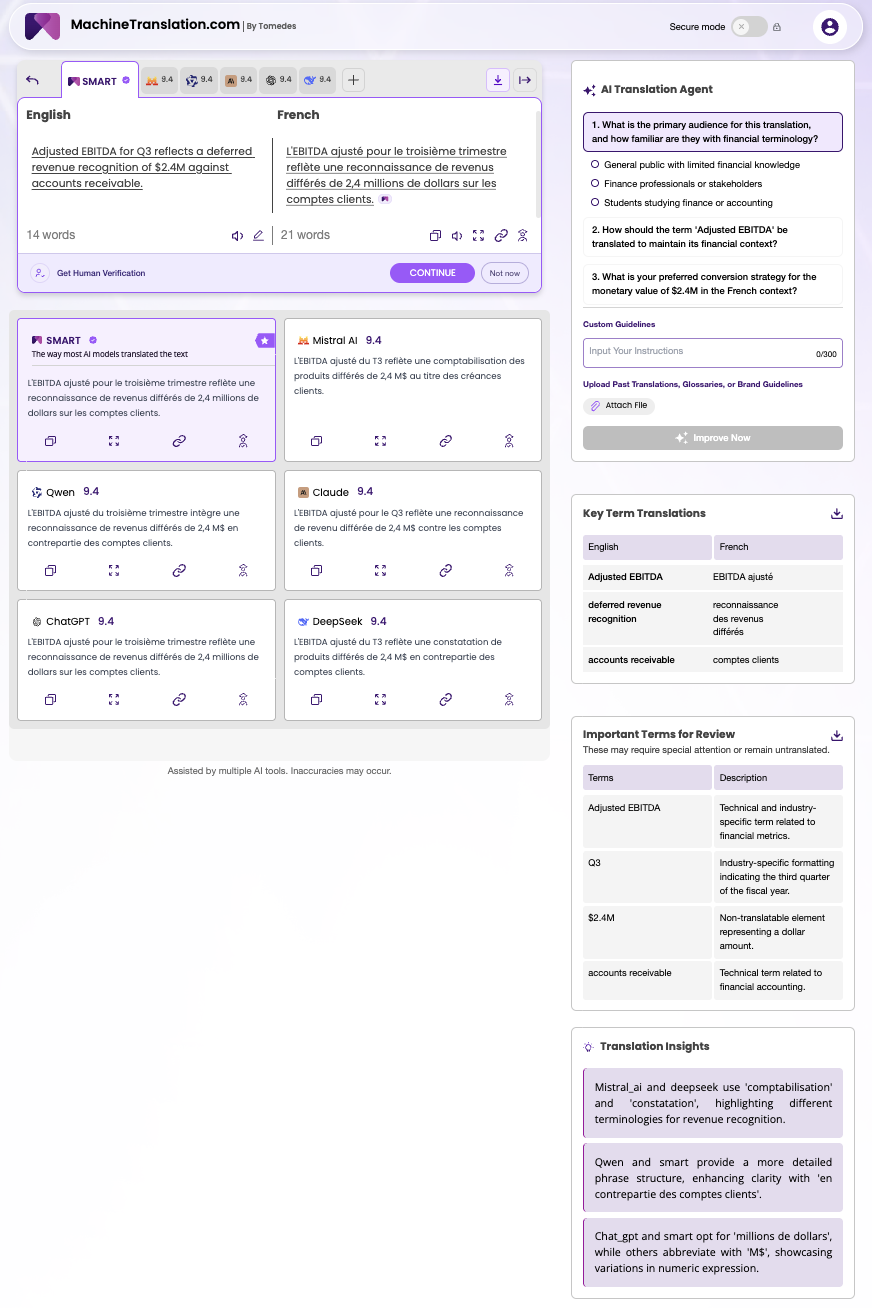
The financial test produced a result that looks like success and contains a problem that accuracy scores cannot capture.
Test phrase: "Adjusted EBITDA for Q3 reflects a deferred revenue recognition of $2.4M against accounts receivable."
All five models scored 9.4. Every output was coherent, professionally phrased French. MachineTranslation.com's Important Terms for Review panel flagged four items correctly: Adjusted EBITDA (technical, industry-specific), Q3 (industry-specific quarter designation), $2.4M (non-translatable dollar amount), and accounts receivable (financial accounting term). These flags mark the terms that warrant human review before the document is used — not because the models failed, but because convention and consistency matter for financial documents in ways that sentence-level accuracy scores do not measure.
The Translation Insights panel documented what those 9.4 scores contained. Three different French accounting terms appeared across the five outputs for the single English word "recognition":
- SMART and ChatGPT used "reconnaissance de revenus différés"
- Mistral used "comptabilisation"
- DeepSeek used "constatation"
- Qwen restructured the clause with "intègre" (integrates), changing the sentence architecture
Comptabilisation, constatation, and reconnaissance are all legitimate French accounting terms. In a standalone sentence, any of them is defensible. In an audited financial report translated over multiple sections, comptabilisation in one paragraph and reconnaissance in the next creates inconsistency — and in a document reviewed by auditors or financial regulators, inconsistency invites questions that delay or complicate approval.
The same issue appeared in number formatting. SMART and ChatGPT wrote "2,4 millions de dollars." Claude and Mistral used "2,4 M$." Both are accepted French conventions. A report that alternates between them across 40 pages reads as internally inconsistent, regardless of whether every individual figure is numerically correct.
This is what financial document translation actually requires from AI: not just per-sentence accuracy, but the ability to identify which terms carry consistency obligations across the full document — and flag the ones where convention choices need to be made once and held throughout. A high model score on individual clauses is a necessary starting point. It is not a sufficient endpoint for documents that go to external stakeholders.
Formatted business documents and technical files
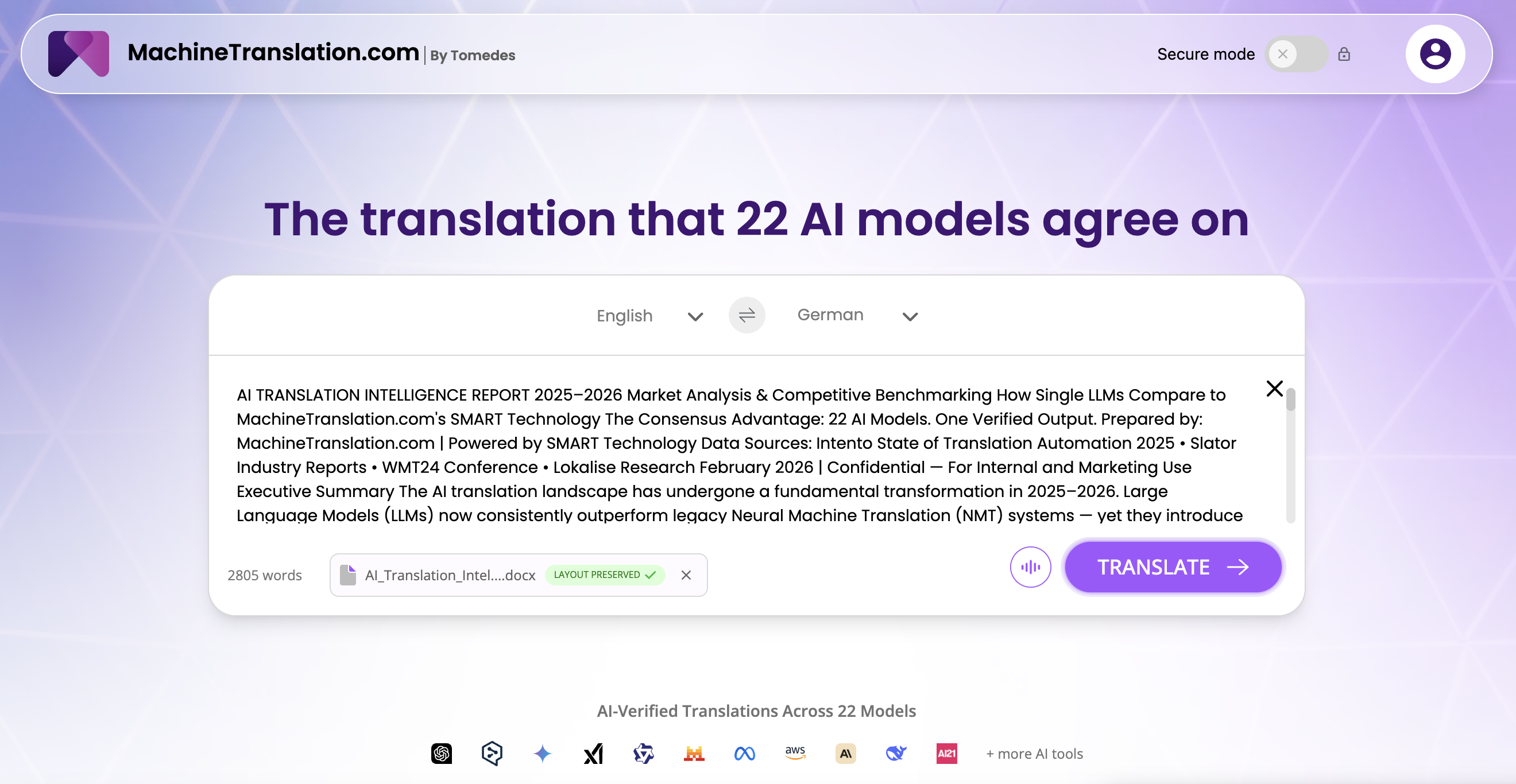
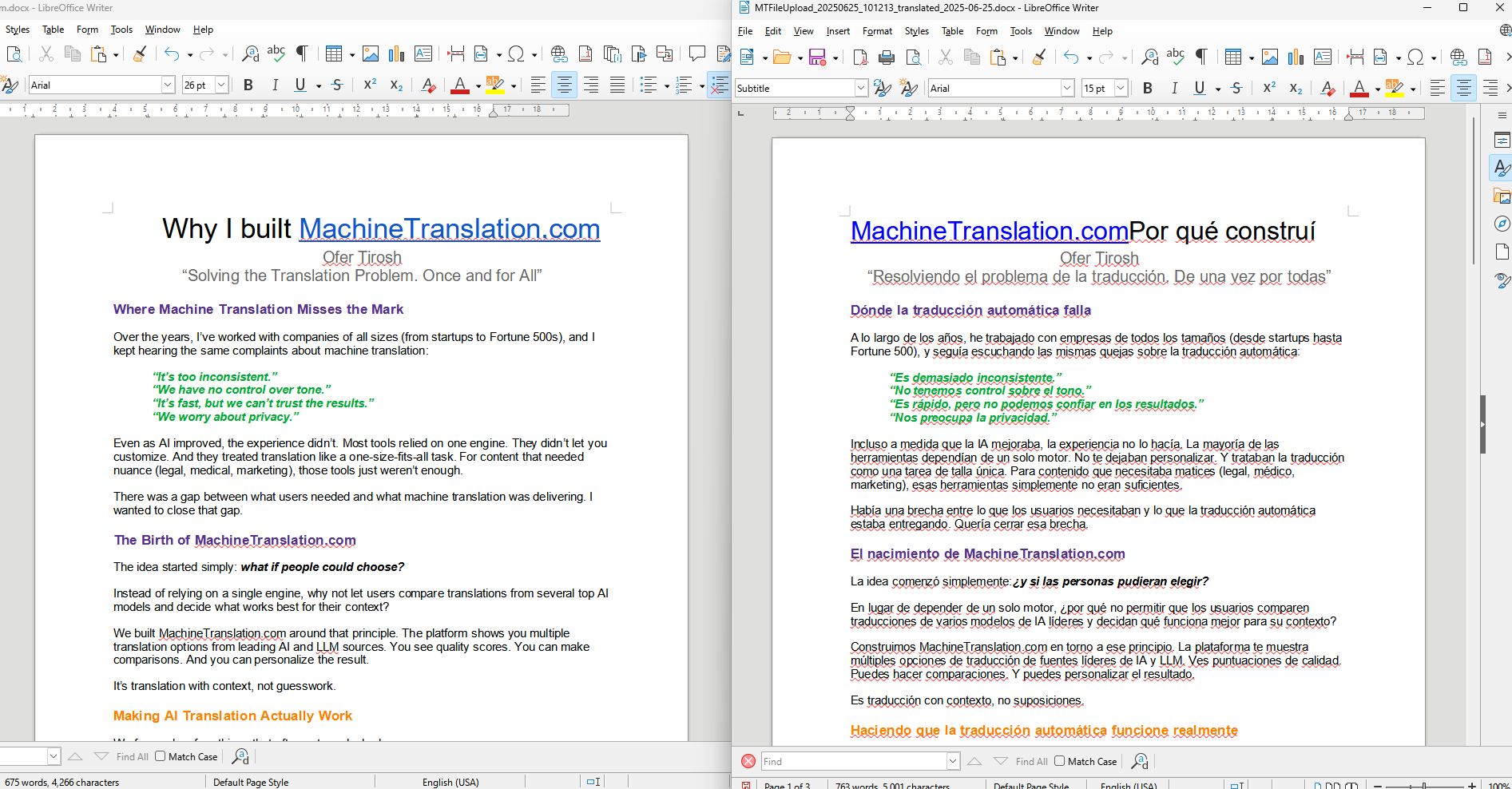
The "LAYOUT PRESERVED ✓" badge visible in MachineTranslation.com's upload interface is not a cosmetic label. It signals that the translated file returns with the structural formatting of the source intact: heading hierarchy, paragraph spacing, table layouts, typography, and section organisation.
For most business documents, formatting is functional. A compliance checklist where the checkbox column becomes a body paragraph is not a usable compliance checklist. A financial report where the table structure collapses is not a deliverable. A technical specification where section numbering breaks cannot be relied on for field reference. In each case, the translation is technically present and practically unusable.
The LibreOffice screenshot above shows what layout preservation looks like in output. The original English document (Ofer Tirosh's published essay "Why I built MachineTranslation.com") was translated into Spanish. In the output file, the bold section headers translate as bold headers. The coloured subheadings translate with colour and formatting intact. The paragraph structure of the original is reproduced in the translation. The Spanish title "Por qué construí MachineTranslation.com" sits in the same typographic position as the English original.
The alternative workflow (export to plain text, translate, rebuild the layout manually) introduces error at every step. Every reformatting pass is an opportunity to drop a heading level, merge two table cells, or lose a footnote reference. For technical manuals, product documentation, and formatted reports distributed to external audiences, the result of that process is a document that required significant time to reassemble and still carries the risk of structural errors introduced during reformatting.
Ofer Tirosh, writing about the gap that prompted him to build the platform, described it in terms that apply equally to format: "For content that needed nuance (legal, medical, marketing), those tools just weren't enough. There was a gap between what users needed and what machine translation was delivering." A translation tool that delivers accurate words in a broken document structure has not bridged that gap.
Compliance and regulatory filings
Compliance documents occupy a specific position in the translation risk landscape. They are often less linguistically complex than legal contracts, but more consequential when key terms are handled generically.
Regulatory filings reference specific statutes, certification identifiers, and jurisdiction-defined terminology. A product safety document prepared for the EU market must use the language of the applicable EU regulation, not a paraphrase that a general AI model produces because it sounds equivalent. A financial disclosure filed with a local securities regulator must use the terminology that regulator expects. An employment compliance document must reflect the labour law categories of the target jurisdiction, not concepts imported from the source country's legal system.
The at-will employment example from the HR section above is a direct precedent for how this fails. A compliance document containing a model's best approximation of "at-will employment" in German (translated fluently, scored highly, but representing a concept German law does not recognise) creates a document that appears compliant and is not. The document is present. The legal meaning required is absent.
What compliance documents require from AI translation is therefore two things operating together: accurate rendering of the standard text, and explicit identification of terms that carry regulatory specificity in the target jurisdiction. The second function is not a language task, it is a domain knowledge task that requires the platform to surface uncertainty rather than resolve it silently into the nearest available equivalent.
For organisations preparing regulatory submissions across multiple jurisdictions, the operational question to put to any AI translation tool is not "how accurate is it?" It is: "does it show me which terms it is uncertain about, and does it tell me when a concept in the source language has no direct equivalent in the target jurisdiction's regulatory framework?"
What these five document types have in common
Each test above produced a different result across a different document type. They share one structural observation: the most consequential translation decisions are the ones that look already resolved.
- The legal clause looked translated. The preposition choice between surjan and derivados (each affecting the scope of a liability limitation) was invisible without a model comparison.
- The HR clause looked translated. The jurisdictional gap between "at-will employment" and German labour law was invisible without a flag. The 0% key-term consensus was the only signal that something required attention.
- The financial clause looked translated, all five models scored 9.4. The terminology inconsistency across three different French terms for "recognition" was invisible without a cross-model comparison.
- The formatted document translated accurately. Layout preservation was only confirmed because the tool returned a structured file, not plain text requiring manual reassembly.
- The compliance filing translates fluently in any single-model output. The regulatory term problem becomes visible only if the platform asks whether the source concept has a target-jurisdiction equivalent.
The common thread is not AI failure. It is invisible AI decision-making. Every model makes choices when it translates — preposition, terminology, whether to translate or approximate an untranslatable term. Single-model tools make those choices without disclosure. MachineTranslation.com's SMART, running across 22 models and surfacing divergences, Key Term consensus, Translation Insights, and human review flags, makes those choices visible at the point of translation — where they are easiest to address.
As Ofer Tirosh described the founding principle of the platform: "It's translation with context, not guesswork." For the five document types above, that distinction is the difference between a translation that is finished and one that is ready to use.
Frequently asked questions
1. Can AI translate legal documents accurately?
AI models can produce high-quality translations of standard legal clauses, scores of 9.4 to 9.5 are achievable on limitation of liability language. For legal documents, however, sentence-level accuracy is not the right measure. The relevant question is whether the tool surfaces the micro-divergences between model outputs that affect enforceability: preposition choices, pronoun use, structural decisions that are grammatically valid in multiple forms but legally distinct. Multi-model comparison makes those differences visible; a single-model output does not.
2. What happens when AI has to translate a concept that doesn't exist in the target language?
A single-model AI will produce its best approximation and present it as a translation. A platform that compares multiple models and tracks term-level consensus will flag that no model agrees on how to handle the term, which is the most important signal available. In the at-will employment test, MachineTranslation.com's Key Term Translations panel registered 0% consensus on the term and the AI Translation Agent asked directly how it should be handled. That flag is what a reviewer needs to make an informed decision.
3. Is a higher accuracy score always a better translation for business documents?
Not for documents where consistency across sections matters. The financial document test showed five models all scoring 9.4 on the same clause while producing three different French terms for "revenue recognition." Every individual output was accurate. In a multi-section report, using all three interchangeably would create an inconsistency that auditors and financial reviewers would flag, regardless of individual sentence quality. Accuracy scores measure sentences; document quality requires consistent terminology across all of them.
4. How does layout preservation work in AI document translation?
MachineTranslation.com accepts DOCX and other common document and image formats and returns translated files with the original structure maintained — heading levels, paragraph formatting, table layout, and typographic styling. The translated file is ready to review and use; it does not require manual reformatting after translation. For technical manuals, compliance documents, and formatted business reports, this is a functional requirement: a translation delivered as unstructured plain text is not a usable document.
5. Which types of business documents should always have human review after AI translation?
Legal contracts, HR documents being used in a foreign jurisdiction, financial documents going to external stakeholders or regulators, and compliance filings all carry enough consequence that human review of flagged terms is the responsible minimum. MachineTranslation.com's "Get Human Verification" option is available directly within the translation interface, allowing users to escalate specific outputs without leaving the platform. For marketing copy, internal communications, and lower-stakes operational documents, AI-only workflows are generally appropriate — but that determination should follow from the document type, not from assumed confidence in the output.