June 4, 2026
We sent 24,000 emails and got a 17% open rate. Here's what we learned.
In May 2026, the MachineTranslation.com team ran its first large-scale email campaign to our full active user list. The goal was straightforward: ask users to leave a review on G2 and remind them why they signed up. We had 24,117 verified, active contacts on the list. We had a clear call to action. We had two subject line variants ready to test.
The results were instructive — not because they were catastrophic, but because the gap between what we expected and what happened told us exactly what we need to fix. This post is a full, unvarnished debrief: what we tested, what the numbers said, what we got wrong, and what we're doing differently from June onward.
This is part of our ongoing commitment to building MachineTranslation.com in public. If you want to follow the product decisions, growth experiments, and honest postmortems as they happen, this is the place.
What were we trying to do?
The campaign had two linked objectives. The primary goal was to grow our review count on G2, an independent software review platform where verified user reviews influence purchasing decisions in the B2B software market. The secondary goal was to re-engage our user base — many of whom had signed up, used the platform, and gone quiet.
We had never sent a campaign at this scale before. Our existing automated emails cover transactional triggers: expiry notices, welcome sequences, cancellation flows. A broadcast campaign to the full active list was new territory for us.
The hypothesis was simple: if a meaningful percentage of active users have gotten real value from MachineTranslation.com, a well-timed, direct ask should convert some of them into reviewers.
That hypothesis held, partially. The open rates were solid. The click-through told a different story.
How we built the list
List hygiene was a deliberate priority. Before the campaign went out, our data team filtered the full contact database down to verified, active users only. Bounced addresses, unsubscribed contacts, and inactive accounts were excluded. The final list came to 24,117 recipients.
We also made a technical decision about the sending domain. Rather than sending from our primary machinetranslation.com domain, we sent from the machine-translation.app domain. The reason: protecting sender reputation. If a large broadcast campaign triggers spam filters or generates an unusual number of complaints, you do not want that signal attached to the domain your entire product operates on. The .app domain serves as a firewall, it keeps our transactional email deliverability clean regardless of how the campaign performs.
This is a standard practice for growth-stage SaaS products, and one we now consider non-negotiable for any future broadcast.
What did the A/B test show?
We ran an A/B test on subject lines before broadcasting to the full list. The warm-up batch (4,000 emails sent to an initial segment) gave us the following results after 24 hours:
- Subject A open rate: 31.27%
- Subject B open rate: 28.7%
- Click winner: Subject B (slightly higher unique click count, though both were low in absolute terms)
Both open rates outperformed the industry benchmark for SaaS email campaigns, which typically runs between 23% and 29% for engaged lists. That was encouraging. Subject A won on opens; Subject B won on clicks. We waited for more data before declaring a winner, then broadcast the remaining 20,000 contacts in batches across two days using the stronger-performing subject.
The full campaign result: a 17.2% open rate across all 24,117 recipients, with a 0.24% click rate and a 0.29% unsubscribe rate (71 total unsubscribes).
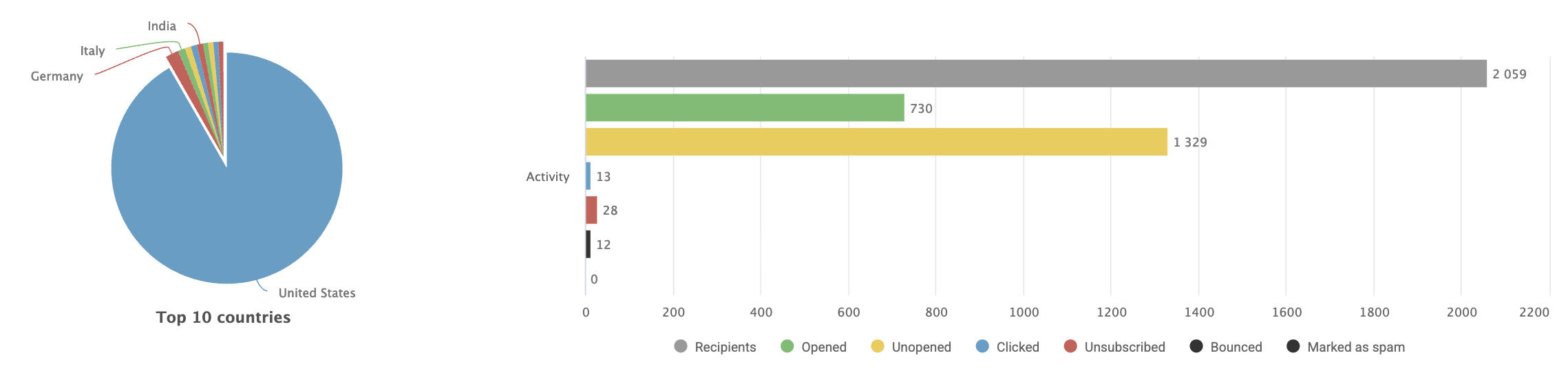
Compared to our campaign from the prior year, which achieved a 34% open rate and a 0.64% click rate, this was a step back on both metrics.
Why did our click rate underperform?
This is the most important question, and we spent time dissecting it honestly.
The primary diagnosis: we didn't A/B test the email body. We tested subject lines carefully but treated the email body as a fixed variable. The prior campaign that outperformed us had a clickable banner — a visual element that gives the reader a clear, low-friction path to action. Our May campaign used a text-only call to action. Open rate is a function of subject line and sender trust. Click rate is a function of what's inside the email. We optimized for one and not the other.
The secondary diagnosis: the ask itself created friction. Asking users to leave a G2 review is a request that requires them to do something for you — create an account on a third-party platform, navigate to a review form, write a response, and submit it. That is a multi-step process. For users who are satisfied but passive, the friction is too high unless the value exchange is more explicit.
Let me put it this way: the platform debate (whether to use G2, Trustpilot, or another channel) was secondary to the content problem. The ask was the issue, not the destination.
The third factor: no segmentation by user type. The 24,117-contact list treated free users, 24-hour subscribers, and Pro subscribers identically. A Pro subscriber who has been on the platform for three months has a very different relationship with the product than someone who used it once for a single document. A review request lands differently depending on that context.
What technical decisions did we make along the way?
Two decisions are worth documenting for anyone running email infrastructure at a similar stage.
Mailgun vs. Resend. We evaluated Resend as a potential alternative to Mailgun during the campaign planning phase. Resend has a cleaner API, a more modern dashboard, and simpler pricing. Mailgun, however, handles our transactional and automated email flows and provides the GDPR compliance infrastructure we need for European users. The conclusion: no immediate switch is warranted, but Resend is worth revisiting if our volume requirements change significantly.
The .app domain decision. As noted above, separating broadcast campaign sending from the primary product domain is something we now treat as mandatory. The distinction protects deliverability for password resets, expiry notifications, and subscription confirmations (the emails users actually need to receive) from the variable performance of marketing sends.
What are we changing for the next campaign?
The debrief produced three concrete changes, not aspirational ones.
1. Value-first content. The next broadcast will not lead with an ask. It will lead with something useful: a promotional code, a feature update the user hasn't seen, or a piece of insight about their translation use case. The G2 ask, if it appears at all, will be secondary. My framing from the internal discussion: emails should remind the user why MachineTranslation.com is worth keeping around, not use up goodwill asking for a favor.
💬 Emails should give value, not ask for things.
2. A/B test the body, not just the subject. Future campaigns will test at minimum two email body variants (one with a visual CTA element, one without) in addition to subject line variants. The prior campaign's success with a clickable banner is a strong enough signal that we won't ignore it again.
3. Segment by relationship depth. Pro subscribers will receive a different email from free users. Users who have performed more than five translations will receive different content from first-time visitors. The list will be split before each campaign, not treated as a single audience.
How often will we email going forward?
The internal debate landed on bi-weekly as the right cadence, roughly every two weeks. Weekly was considered too frequent for a product-focused email program at our current content volume; it risks exhausting goodwill before we have enough fresh value to share. Monthly felt too slow given the pace of product updates happening on the platform right now.
The content calendar will prioritize: new feature announcements, platform performance data that users would find interesting, occasional promotional offers, and (yes) review requests, but framed as part of a value exchange rather than a cold ask.
For users curious about what's happening inside the product as we build it, the newsletter is the best direct signal. If you are not already on the list, you can sign up at MachineTranslation.com.
Try MachineTranslation.com — Pro Plan from $19/month · 24-Hour Unlimited Translations from $6
Pricing current as of June 2026 and subject to change.
About the author
William Mamane
Chief Marketing Officer, Tomedes
Connect on LinkedIn →