July 21, 2026
Why your quiz funnel converts less once you go international
The quiz that converts at 40% in English can quietly lose half of that once it's serving visitors in Spanish, German, or Japanese, and completion rate alone won't tell you why.
A marketing team builds a quiz funnel, gets it converting well in English, then translates it for three new markets in an afternoon. The dashboard shows completion rate dropping in every new language, and nobody can say exactly why. The words are all correct.
That's usually the first sign something is off. A quiz funnel isn't a static page. It's a short, personal conversation with a visitor, built entirely out of tone, timing, and phrasing choices that a plain landing page never has to make. When that conversation gets translated word-for-word instead of consensus-checked, it doesn't break in an obvious way. It just stops landing.
What is a quiz funnel, exactly?
A quiz funnel is a marketing structure that uses an interactive quiz, like a personality quiz, a skincare-routine finder, or a "what's your marketing style" assessment, to segment a visitor by their answers, then leads them to a personalized result and a conversion step: an email capture, a product recommendation, a plan suggestion. It converts better than a blank lead form because a visitor experiences it as getting something, not filling out something.
Interact's annual quiz benchmark report puts average opt-in rates north of 40%, well above what a standard landing-page form typically pulls, which is a large part of why the format keeps showing up across B2B lead-gen and ecommerce product recommendations.
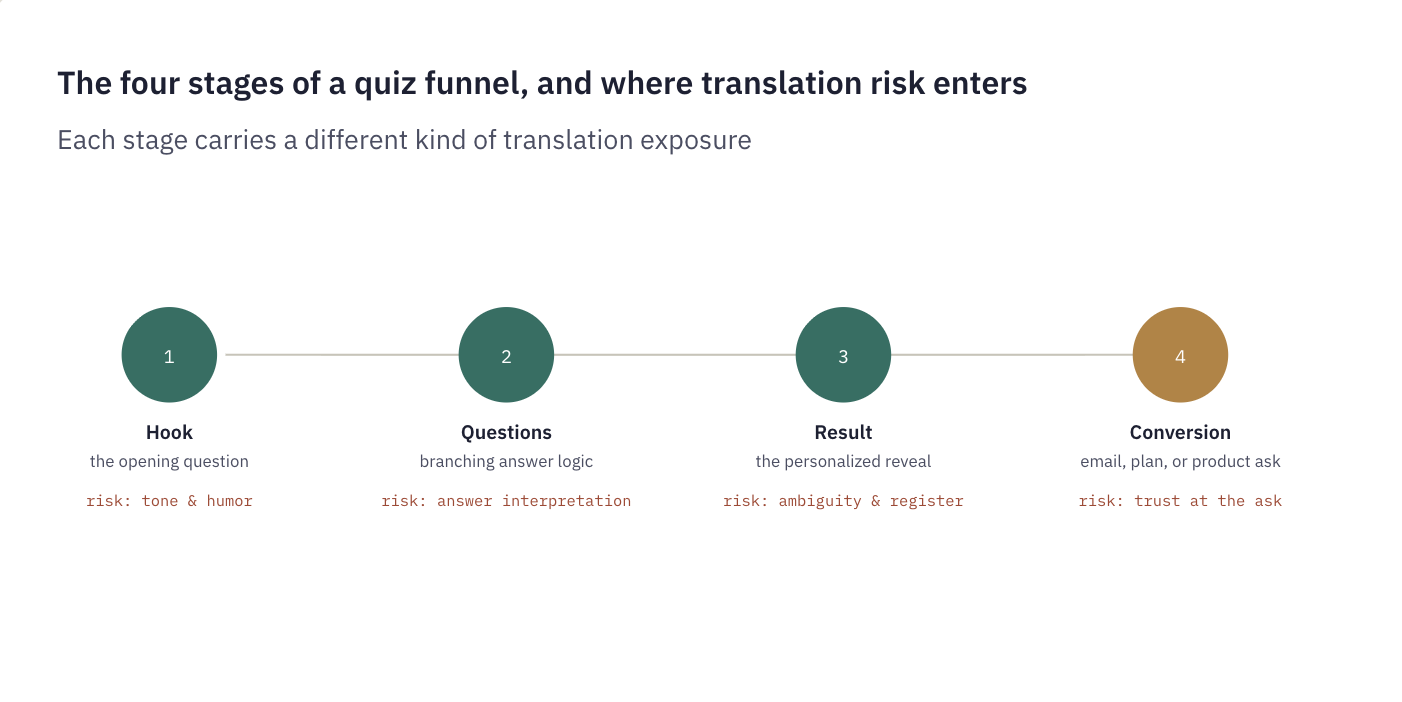
The structure is simple and repeats across almost every quiz funnel built for business:
Why a quiz funnel is more translation-sensitive than a landing page
A landing page describes a product. A quiz funnel talks to the visitor directly, in the second person, at the exact moment it's asking them to trust a personalized judgment about them. That's a much narrower target for translation to hit. A pricing page can survive a slightly flat sentence. A quiz result that's supposed to feel like it "gets" the visitor cannot.
Every stage in the diagram above depends on a translation choice that a single AI model has to make silently, without asking the business first. Most of the time, nobody checks whether it made the right one.
What happens when a joke doesn't survive translation
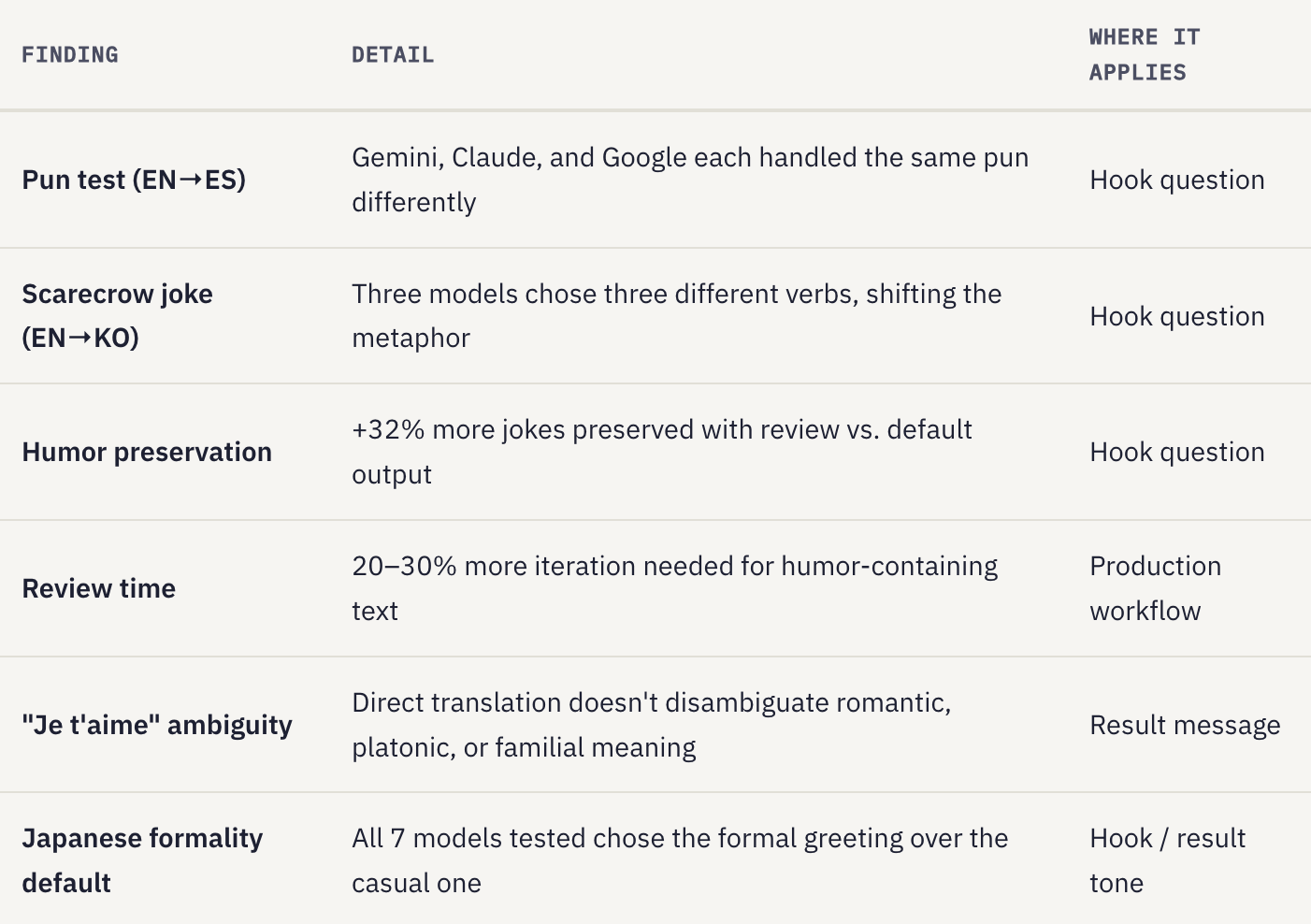
The clearest evidence for this comes from a joke-translation test MachineTranslation.com ran across its own model panel. The source line was the classic pun, "Time flies like an arrow; fruit flies like a banana," translated from English into Spanish. Gemini best retained the pun structure, Claude softened the punchline with "prefieren," and Google lost the double meaning entirely. Three different models produced three different outcomes from the exact same sentence.
The pattern held in a separate test with a scarecrow joke translated into Korean: Google, Gemini, and Grok each chose a different verb for "outstanding in his field," and each choice shifted the metaphor's weight in a slightly different direction. None of the outputs were wrong, exactly. They just didn't agree with each other, which means at least two of them missed what the source line was actually doing.
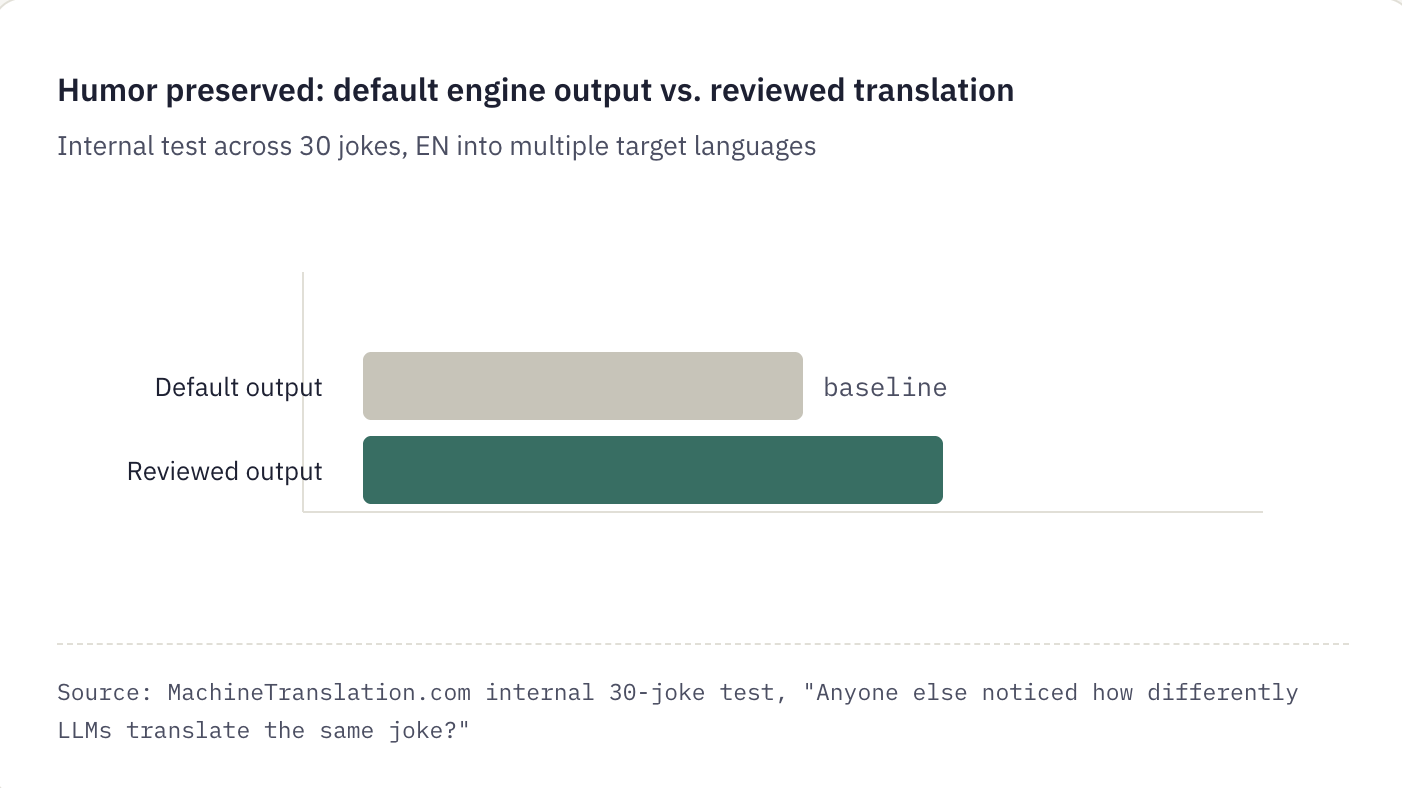
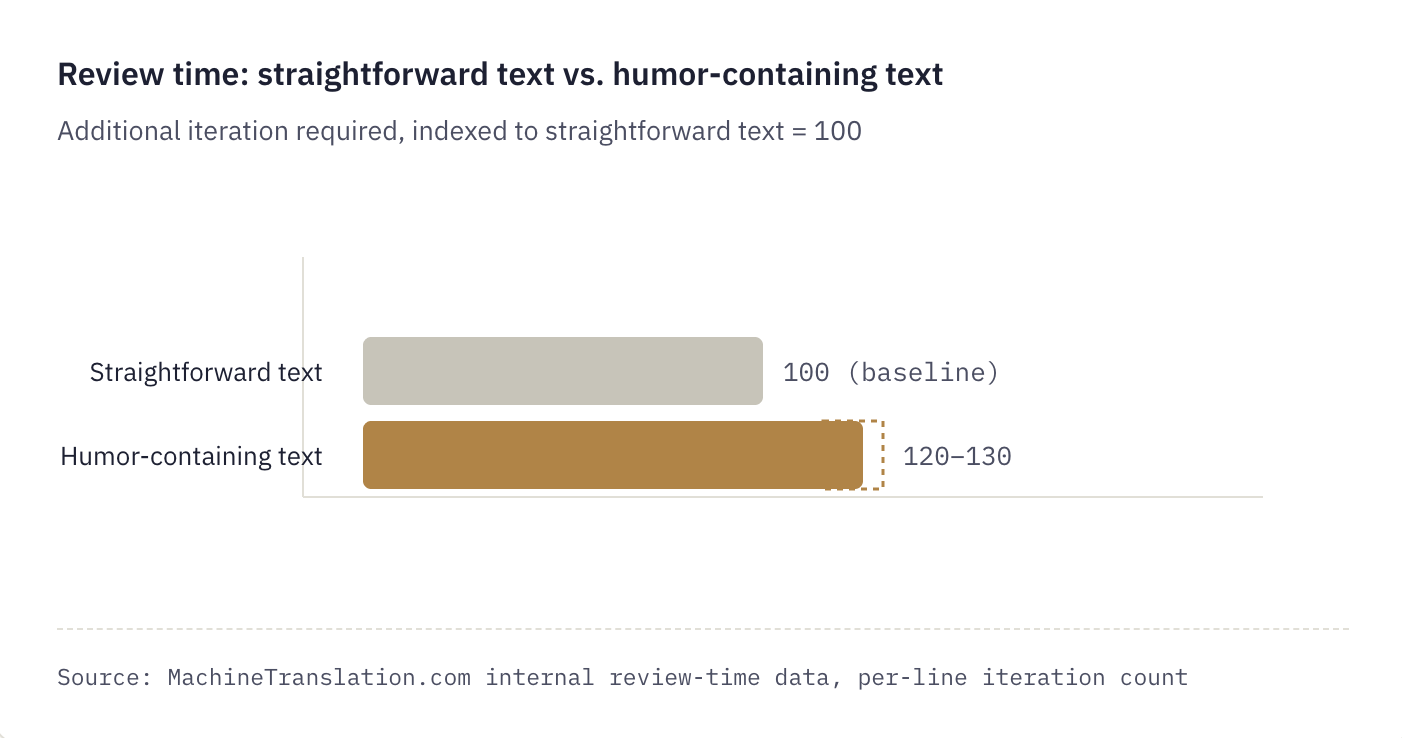
The gap closes when a candidate-term selection process and a human review step are added on top of the default engine output: across the same 30 jokes, that combination preserved the humor in 32% more cases than taking the first model's answer as final. The cost is time, not magic. Humor-containing lines in that same dataset needed roughly 20 to 30% more review time and iteration than straightforward text, because there's genuinely more than one reasonable way to say it, and someone has to pick.
For a quiz funnel, that hook question is usually the one place a business deliberately chose a joke or a wink of personality to earn the click. It's also, per this data, the single most likely line in the whole funnel to come out flat in translation if nobody reviews it.
The silent decisions your quiz funnel is already making
Humor isn't the only thing that gets decided without anyone noticing. Two smaller, more common examples show the same pattern in plainer language.
Every AI model tested agreed on "Je t'aime" as the French translation for "I love you," reasonably enough, since that's the standard phrase. But the phrase carries romantic, platonic, or familial meaning depending on context, and a direct translation doesn't disambiguate which one applies. A personality-quiz result that tells someone "you clearly love X" runs into exactly this kind of ambiguity, and the model has no way to know which register the business actually intended.
Formality runs into the same wall. All seven models tested chose the formal おはようございます over the casual おはよう for "good morning" in Japanese, a single, silent formality decision made the same way across every model, without anyone asking whether a playful consumer quiz actually wanted the formal register or the casual one.
Neither example is a mistake in the sense of being factually wrong. Both are a business's voice getting decided by default instead of on purpose, at the exact two or three lines in a funnel where voice is the entire point.
Lead-gen and product-recommendation quizzes specifically
Personality quizzes can absorb a slightly flat joke and still work. Lead-gen and product-recommendation quizzes have less room, because the result page is the moment the business is asking for something back (an email address, a purchase, a demo request) right after making a specific claim about what the visitor needs.
Businesses typically build these funnels with dedicated quiz software that handles the branching logic, timers, and result screens. For example, tools like Quiz Maker by AYS are built for exactly this kind of setup. What that software can't see is what happens after the visitor's answers get mapped to a translated result message: whether the recommendation still reads as confident and specific, or whether it's quietly drifted into something vaguer, once it's rendered in German or Japanese instead of English.
That distinction matters more than it sounds. A slightly-off joke costs a smile. A slightly-off product recommendation costs the conversion the entire funnel exists to produce.
What actually fixes this
None of the examples above are solved by finding a single "correct" model and using it everywhere. Gemini won the pun test; a different model would likely win a different one. The pattern across all of this data is that models disagree with each other in specific, identifiable ways. That disagreement, once you can see it, is a signal, not just noise.
That's the basic logic behind checking a translation against more than one model instead of trusting the first answer: when several models land on the same phrasing, that's a reasonable sign the translation is solid. When they split, the way they split on the pun, the scarecrow joke, or "Je t'aime," that's exactly the line worth a second look before it goes into a live quiz funnel. MachineTranslation.com's SMART consensus is built around that comparison, flagging the phrases models disagree on rather than silently picking one and moving on.
For a quiz funnel specifically, that means the hook question, the branching answer choices, and the result message are the three places worth checking against more than one model before a translated version goes live, not the entire funnel uniformly, and not just once at launch.
That kind of checking is also getting easier to reach for directly. MachineTranslation.com now runs an MCP server, so a subscribed users can call the MachineTranslation.com'ssmart_translate function from inside Claude (or any other AI assistant) itself, without leaving the document or draft where a quiz's hook line or result copy is actually being written. A recent setup guide walks through connecting it in four steps, and the underlying request still runs through the same 22-model panel behind every example in this article. For a marketing team iterating on a quiz funnel's hook question in real time, that means a consensus check is a prompt away, not a separate tool to open.
Frequently asked questions
1. What is a quiz funnel?
A quiz funnel is a marketing structure that uses an interactive quiz to segment a visitor by their answers, then leads them to a personalized result and a conversion step, such as an email capture or product recommendation. It converts better than a blank lead form because the questions feel like value, not a form.
2. Why do quiz funnels convert worse internationally?
A quiz funnel depends on tone, humor, and personalized result text landing exactly right. Literal or single-model translation often preserves meaning but loses the emotional register, so the same funnel that feels charming in English can feel flat, confusing, or oddly formal in another language.
3. Can AI translation handle humor and tone accurately?
Single AI models frequently disagree on how to handle humor, and most default to preserving literal meaning over comedic effect. Testing across multiple models and reviewing where they disagree catches far more of these cases than relying on one model's first output.
4. Should a lead-gen quiz be translated by AI or by a human?
The result message is the highest-risk part of a lead-gen or product-recommendation quiz, since it's the moment a visitor decides to trust the recommendation. A consensus-checked AI translation with human review at that specific step is more reliable than translating the entire funnel uniformly.

By MachineTranslation.com Team
Connect on LinkedInThe MachineTranslation.com team writes about AI translation, language technology, and the future of multilingual communication.
Share:


