September 30, 2026
Qwen vs ChatGPT: Which AI model translates better?
ChatGPT's current generation and Qwen are both part of the pool of models MachineTranslation.com runs on every translation, not two outside challengers being judged against the platform itself. Run the same text through both on identical segments, and ChatGPT wins the larger share of language pairs overall. Split the results by direction, and the picture narrows sharply in one specific place: translating into English, where the two are close to even.
Is there any AI better than ChatGPT for translation?
General interest in alternatives to ChatGPT has grown as competing models have improved, though the reasons vary widely by use case and there's no single explanation. For translation specifically, the more useful question is which model actually performs better on a given language pair, a testable question rather than a matter of sentiment.
Over MachineTranslation.com's last 28 days of traffic, both models translated identical source text across 98 language pairs. ChatGPT scored higher in 77 of those pairs; Qwen scored higher in 21. The weighted average across matched output puts ChatGPT at 9.10 out of 10 and Qwen at 8.98, a real but modest gap on average that hides a much sharper split once direction is factored in.
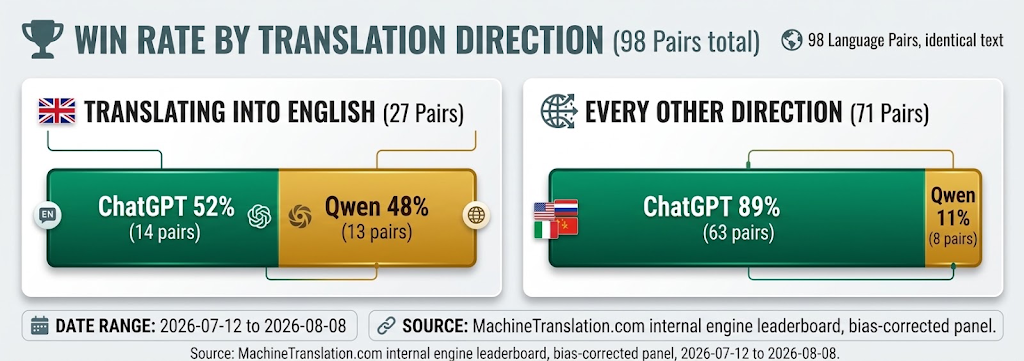
Into English, the two models are close to tied. In every other direction, ChatGPT wins the large majority of pairs tested.
| ChatGPT | Qwen | |
|---|---|---|
| Percent of output scored | 54.76% | 42.6% |
| Average score | 8.89 / 10 | 8.87 / 10 |
| Bottom 10% of scores | 7.8 | 7.6 |
| Win rate, into English | 52% | 48% |
| Win rate, every other direction | 89% | 11% |
Why does the gap nearly disappear translating into English?
The data shows where the split happens, not why. What's clear is that Qwen's competitiveness isn't spread evenly. Out of 27 pairs where the target language is English, Qwen takes 13, essentially a coin flip. Out of the remaining 71 pairs, both translating out of English and between two non-English languages, ChatGPT wins 63, or 89% of them. A team assuming Qwen's into-English performance carries over to outbound or non-English-pair translation would be drawing the wrong lesson from the wrong direction.
Is Qwen a Chinese company, and does that matter for translation?
Qwen is developed by Alibaba Cloud, based in China. On its own, that doesn't change how well the model translates a given sentence, the data above reflects actual output quality regardless of where a model is built. Where it can matter is data handling: businesses translating regulated or sensitive content (contracts, medical records, personal information) should treat the question of where an AI provider processes and stores that content as a real due-diligence item, separate from translation quality itself. That applies to any AI provider, not Qwen specifically, and it's part of why MachineTranslation.com publishes its own data handling and security practices directly rather than leaving the question unanswered.
Is either model more reliable for legal and business translation?
Not consistently, and the divergence isn't always about which model scores higher. MachineTranslation.com's testing across real contract language found two separate cases worth knowing before trusting either model on legal text. Idiomatic language runs the other way at times: a separate head-to-head test found ChatGPT translating a German idiom literally and incorrectly while Qwen found the correct idiomatic meaning, a reminder that neither model's overall lead in the aggregate data holds true sentence by sentence.
| Test case | ChatGPT | Qwen |
|---|---|---|
| "At-will employment" into German | Usable, functional phrasing | Reached for an unrelated legal concept |
| Limitation-of-liability clause into Spanish | "que surjan de" | "derivados de" (scope-altering difference) |
| "Ich verstehe nur Bahnhof" (German idiom) | Translated literally, incorrect | Correct idiomatic meaning |
Neither model wins consistently across these three cases: a single model's aggregate score doesn't predict its behavior on any one specific term or phrase. It's also why legal and contractual text benefits from a human verification step regardless of which model produced the first draft.
What about language coverage?
Neither ChatGPT nor Qwen publishes a verified, independently confirmed list of language pairs where translation quality drops off. Both are general-purpose models with broad multilingual training, which is a different claim than measured translation performance across a specific language set. MachineTranslation.com tests and scores translation quality across 330+ languages directly, rather than relying on a model's general language capability as a stand-in for how well it actually translates.
What shouldn't you paste into ChatGPT or Qwen for business translation?
Neither ChatGPT nor Qwen was built as a dedicated translation platform, and pasting sensitive business content directly into a general-purpose chat interface carries the same data handling questions as pasting it into any other consumer AI tool: where the input is processed, whether it's retained, and who can access it. Contracts, medical records, immigration documents, and financial statements are exactly the kind of content where that question is worth answering before translating, not after. This is a genuine reason a dedicated translation platform with published, verifiable data handling practices is a different proposition from a general-purpose chat interface, regardless of which model sits underneath either one.
How MachineTranslation.com actually uses both models
MachineTranslation.com runs ChatGPT, Qwen, and more than 20 other AI models on every translation, then surfaces the version those models most agree on. Given how sharply Qwen's and ChatGPT's performance splits by direction, picking one model as a standing default would mean guessing wrong on a predictable share of language pairs. The same direction-dependent pattern shows up in MachineTranslation.com's Qwen vs DeepSeek comparison. For the full picture of how current models are tested against each other, see MachineTranslation.com's full model comparison testing.
Frequently asked questions
1. Is Qwen or ChatGPT better for translation?
Across 98 language pairs tested on identical source text, ChatGPT scored higher in 77 of them. Qwen's strongest showing is translating into English, where the two are nearly tied. In every other direction, ChatGPT wins the large majority of pairs, so the honest answer depends heavily on which direction the content is moving.
2. Does ChatGPT or Qwen support more languages?
Both are general-purpose AI models without a verified, published list of language-specific limitations. Neither publishes independently confirmed language-pair coverage data, which is different from a platform that tests and scores translation quality across 330+ languages directly, rather than relying on general claims about multilingual training.
3. Is Qwen or ChatGPT better for legal and business translation?
Neither is reliably better across the board. Testing a German employment law term, DeepSeek and ChatGPT produced usable functional phrasing while Claude and Qwen both invoked an unrelated legal concept, showing the split runs by term and context, not by which model is generally stronger.
4. Does MachineTranslation.com compete with ChatGPT and Qwen?
No. MachineTranslation.com runs ChatGPT, Qwen, and more than 20 other AI models on every translation and surfaces the version those models most agree on. It tests and combines models like these rather than acting as a separate, competing model of its own.
5. Which model should I pick for a large localization project?
Neither one alone is a safe default once content moves across many languages in both directions. The direction-specific split documented here means a model that performs well translating into English may perform very differently translating out of it, across dozens of language pairs at once.
6. Which Qwen model is best for translation?
This isn't available yet. MachineTranslation.com's tracking currently records Qwen as a single engine without a model-version tag, unlike other providers, so per-sub-version quality data doesn't exist to report. Once that's fixed, a real breakdown between Qwen3.8-Max and Qwen3.8-27B will be possible; for now, this is a genuine gap, not just an unmeasured detail.

By Rachelle Garcia
Connect on LinkedInRachelle leads product and AI at Tomedes, where she runs the experiments that turn internal data into better translation experiences. She writes about what actually happens when you build AI products such as MachineTranslation.com — the numbers, the surprises, and the parts that don't go to plan.
Share:


