June 10, 2026
We're about to give paying users better AI models, here's why we're doing it
I want to share something we decided this week — not after it shipped, but while we're still building it.
We're changing how AI models are allocated across our user tiers. Paying users on MachineTranslation.com will soon get access to our most advanced AI models. Free users will continue to get capable, reliable translation — but not the same models. That gap is intentional, and I want to explain exactly why we're making this call.
I'd rather write this now, while the reasoning is fresh and the decision is still a little raw, than wait until it's live and frame it as a polished announcement. The honest version is more useful.
Table of contents
- Why we've been thinking about this for a while
- What changed our minds: The internal test
- The honest reason for tiering
- What this will look like for users
- What we're still figuring out
- FAQ
Why we've been thinking about this for a while
MachineTranslation.com translates with 22 AI models at once and uses a consensus-based approach to surface the best output. That's always been the core of what we do — not betting everything on one model, but comparing across several and letting the outputs speak for themselves.
The uncomfortable side of that approach is that it makes the quality differences between models very visible. We see, every day, that not all models handle all text equally well. And for a long time, we didn't let that observation change how we allocated models to users.
Not all models are equal, and we have the data to prove it
A few weeks ago, Rachelle (our AI lead) walked us through an internal tool we'd built to test translation quality across multiple GPT models simultaneously — including GPT 4.1 nano, GPT 4.1 mini, GPT 5.4 mini, and others. You put in the same source text, and you see every model's output side by side.
What that tool makes immediately clear is this: on simple, short, everyday text, the outputs are nearly identical. You genuinely cannot justify a quality argument for premium models on "the meeting is at 3pm."
But on anything with real linguistic complexity (idiomatic phrasing, domain terminology, long documents where context needs to carry across thousands of words) the gap between models opens up, and it opens up in ways that matter professionally.
Where cheaper models quietly fail
This is the part I think the translation industry doesn't talk about honestly enough. Cheaper, faster models don't usually produce obviously wrong translations. They produce translations that read fine on the surface but carry subtle errors that a subject-matter expert (a lawyer, a medical professional, a senior localisation manager) would catch immediately.
A conditional clause rendered with the wrong sense. A legal term that means something specific in that jurisdiction, translated as its everyday equivalent. A register drift halfway through a long document that undermines the professional credibility of the whole thing.
The failure is quiet. And quiet failures in professional translation can be expensive.
What changed our minds: The internal test
We didn't make this decision based on intuition. We ran the models against complex, idiomatic source text (the kind of content our professional users actually need translated) and we had linguists evaluate the outputs.
The result was clear. Advanced models handled nuance, register, and domain-specific terminology consistently better. The cheaper models were more than adequate for casual use. The two use cases genuinely require different tools.
Four models, same sentence, very different results
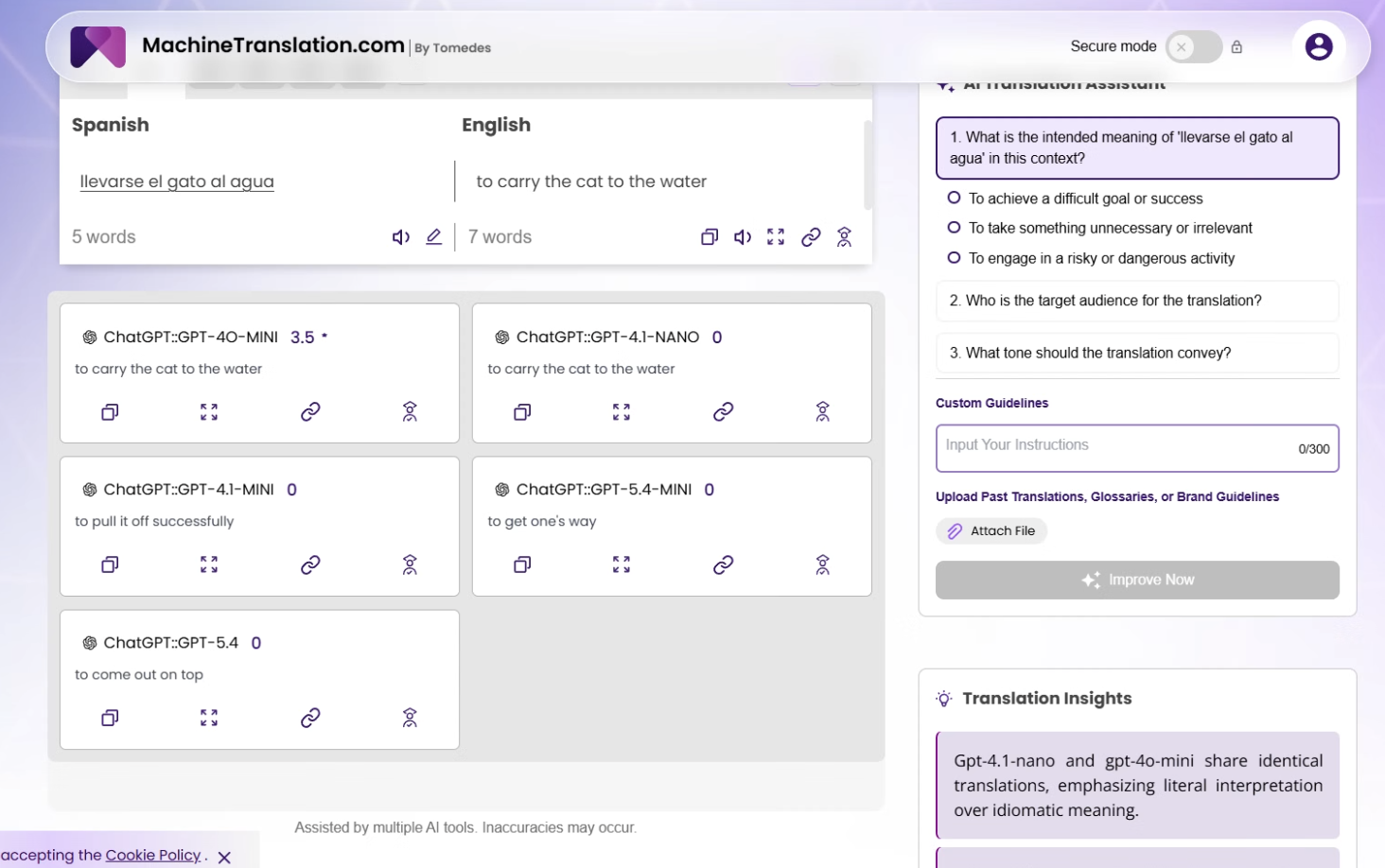
The conversation this sparked internally was less about pricing and more about honesty. If we know the models perform differently on professional-grade content, and we know our paying users are largely translating professional-grade content, then giving them the same model as a free user who's translating a casual email is a disservice to both.
The honest reason for tiering
Ofer (our CEO) put it plainly in our internal discussion:
💬 "Cheaper models carry real quality risks on complex or idiomatic text. Giving every user our best model regardless of plan isn't sustainable — and more importantly, it obscures what professional-grade translation actually costs to deliver."
That framing stuck with me. It's not just a cost argument. It's a clarity argument.
What premium models actually cost to run
The more capable AI models cost meaningfully more per token to run. That's not a MachineTranslation.com policy, it's how these models are priced by their providers. Running our most advanced model across every free translation, every casual query, every "what does this sign say" request, would significantly inflate our infrastructure costs.
More importantly, it would mean cross-subsidising low-complexity use cases with the compute budget we need to maintain quality for professionals translating 10,000-word technical documents. That's not a sustainable or sensible allocation.
Why pretending all tiers are equal doesn't serve anyone
There's a version of this decision that's purely mercenary — charge more, give more, simple. That's not actually what's driving it.
What's driving it is that we've built a platform that can genuinely surface quality differences between AI models. We have the internal tooling to see those differences clearly. Choosing to ignore that visibility when we design our user tiers would be a kind of dishonesty, pretending the gap doesn't exist when we have evidence it does.
Free users deserve to know what they're getting. Paying users deserve to know they're getting something meaningfully different. Blurring that line helps neither group.
What this will look like for users
We're still working out the implementation details, so I want to be careful not to over-promise specifics. But here's the direction.
Where the free tier stays strong
Free plan translations will continue to use capable AI models. For the majority of everyday translation tasks (short messages, casual reading, basic correspondence), free users will get accurate, reliable output. That's not changing.
The free tier exists because we believe language shouldn't be a barrier, and we're not walking that back.
Where paying users pull ahead
The difference will be most visible on:
| Content type | Why model quality matters here |
|---|---|
| Legal and financial documents | Conditional clauses, jurisdiction-specific terminology, register consistency |
| Technical documentation | Domain-specific vocabulary, long-document coherence |
| Medical and clinical text | Precision, register, sensitivity to ambiguity |
| Marketing and brand copy | Idiomatic handling, tonal accuracy, cultural resonance |
| Low-resource language pairs | Thinner training data means bigger model quality gaps |
| Long-form documents (5,000+ words) | Context retention, consistency across the full document |
For professional users working in any of these categories, the model tier will make a real difference. That's exactly who the Pro plan is built for.
What we're still figuring out
I want to be honest that this isn't all resolved yet.
We're still determining the exact model allocation — which models sit at which tier, and how we communicate that clearly to users inside the product. We're working through the paywall logic to make sure the experience is seamless, not jarring. And we're thinking carefully about how to present model quality information to users in a way that's genuinely useful rather than just a marketing claim.
There's also a real question we're sitting with: how do we help a free user understand, in the moment, when they've hit a use case where upgrading would meaningfully improve their output? That's a UX challenge as much as a product one, and we don't have the full answer yet.
I'll write about how this lands once it's live. For now, this is the thinking.
If you're a paying user and you want to weigh in on what matters most to you in model quality, I'm genuinely interested. Drop a message via the MachineTranslation.com contact page.
FAQ
1. Why is MachineTranslation.com changing how models are allocated?
Because our internal testing showed a meaningful quality gap between model tiers on professional-grade translation tasks. We built a tool to compare multiple AI models simultaneously, and the data made the case clearly: advanced models handle complex, idiomatic, and domain-specific content significantly better. The tier change reflects that reality honestly.
2. Will free plan translations get worse when this launches?
No. Free plan users will continue to get capable, accurate translations for everyday use cases. The change is that the paying users will get upgraded to our most advanced models, not that free users will be downgraded.
3. What types of translation benefit most from premium AI models?
Legal, financial, medical, technical, and long-form documents — and any content in less common language pairs where training data is thinner. For short, simple, everyday text, the difference between model tiers is minimal.
4. When will this go live?
We're building it now. I'll post an update when it ships, including what the experience looks like in the product and what the early data shows.
5. How does MachineTranslation.com decide which AI model is best for a given text?
We run multiple models simultaneously and use a consensus-based scoring approach to evaluate outputs. Our internal comparison tool lets us test quality across model tiers on the same source text, that's what informed this tiering decision. You can learn more about how the MachineTranslation.com.com consensus system works.
Try MachineTranslation.com — Pro Plan from $19/month · 24-Hour Unlimited Translations from $6
Pricing current as of June 2026 and subject to change.
About the author
William Mamane
Chief Marketing Officer, Tomedes
Connect on LinkedIn →